
Collaborative Philanthropy as an Asset Class: Unlocking Greater Impact Through Pooled Giving — Alison Powell, Kimberly Dasher Tripp & Neha Dalal
Collaborative philanthropy is emerging as one of the most promising innovations in modern giving.
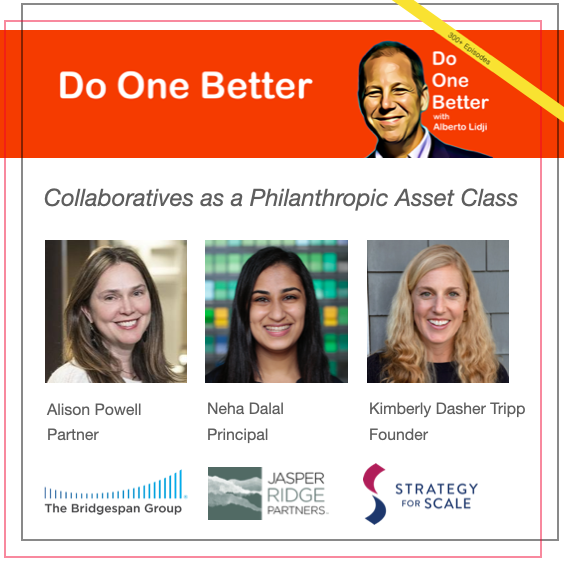
In this episode of the Do One Better Podcast, host Alberto Lidji is joined by three leading voices in collaborative philanthropy: Alison Powell, Partner at The Bridgespan Group and leader of its Collaborative Philanthropy practice; Kimberly Dasher Tripp, Founder of Strategy for Scale; and Neha Dalal, Principal at Jasper Ridge Partners, where she advises families and foundations on strategic philanthropy and impact. Together, they explore the growing role of collaborative funds as a powerful vehicle for scaling philanthropic impact.
Drawing on their jointly authored article, Collaboratives as a Philanthropic Asset Class, the guests examine how expert-led pooled funds are reshaping the philanthropic landscape. They explain why collaborative funds—vehicles that aggregate capital from multiple donors and deploy it through a shared strategy—can help address some of philanthropy’s most persistent challenges, including fragmented giving, limited donor capacity, and the difficulty of identifying and supporting the highest-impact opportunities.
The conversation explores the analogy between collaborative funds and investment vehicles such as mutual funds, ETFs, and venture capital funds. Just as investors rely on professional fund managers and diversified portfolios, donors can leverage collaborative funds to access deep expertise, rigorous diligence, strategic coordination, and greater reach than they might achieve on their own.
Alison, Kimberly, and Neha discuss the remarkable diversity of collaborative funds operating today—from issue-focused initiatives addressing climate change, gender equity, poverty, global health, and education, to community-led funds that place decision-making power in the hands of those closest to the challenges being addressed. They also examine how collaborative funds can help donors learn while giving, build relationships with peers, and participate in communities of practice focused on shared impact goals.
The discussion addresses common misconceptions and critiques of collaborative giving, including concerns about intermediary costs, loss of donor control, and potential duplication within the philanthropic ecosystem. The guests explain why these considerations are best understood as trade-offs rather than shortcomings, and how collaborative models can often increase both efficiency and effectiveness while mobilizing significantly more capital toward urgent social and environmental challenges.
The episode also explores the infrastructure needed to support the continued growth of collaborative philanthropy, including improved discovery tools, clearer evaluation frameworks, and stronger field-building efforts that help donors identify and engage with collaborative opportunities aligned with their values and objectives.
Whether you are an experienced philanthropist, an emerging donor, a family office advisor, or simply interested in how resources can be deployed more effectively for social impact, this conversation offers a compelling perspective on why collaborative funds may become an increasingly important part of the future of philanthropy.
Key Topics Covered
What collaborative philanthropy funds are and how they operate
Why collaborative funds can be viewed as a philanthropic asset class
The parallels between collaborative giving and investment fund models
How collaborative funds increase efficiency, expertise, and scale
The role of community leadership, proximity, and power-sharing in philanthropy
Different collaborative fund structures, governance models, and strategies
How donors can determine whether collaborative giving is right for them
The importance of donor self-awareness and philanthropic strategy
Common barriers to collaborative giving and how they can be overcome
The infrastructure needed to strengthen the collaborative philanthropy ecosystem
Why many practitioners see collaborative funds as a key part of philanthropy’s future
Memorable Insights
Collaborative funds allow donors to leverage expert knowledge, shared diligence, and collective action.
Giving through a collaborative fund does not replace direct philanthropy; it complements it.
Many of philanthropy’s biggest challenges are too large and interconnected for any single donor to address alone.
Collaborative funds can help move capital more quickly, strategically, and at greater scale.
The future of philanthropy may depend on helping donors move from acting alone to acting together.
About Alison Powell
Alison Powell is a partner and head of Bridgespan’s philanthropic collaboratives practice out of the San Francisco office.
Alison's work supports Bridgespan’s goal of unlocking significant philanthropic resources toward equity and justice. She co-leads our work on philanthropic collaborative vehicles, supporting clients directly as well as developing related research for the sector at large. She currently leads a pilot program called "Unlocking Impact" that helps individual donors align resources with their impact goals and values. Alison also works with our internal philanthropy practice to bring resources to bear across our six global offices.
Before joining Bridgespan in 2006, Alison worked for Mattel to ideate, develop, and launch toy product lines. She started her career at The Parthenon Group, a management consultancy where she worked on a host of strategic engagements, from motorcycle manufacturing to publishing.
Alison graduated cum laude with an AB degree in politics from Princeton University and received her MBA from Berkeley’s Haas School of Business.
About Kimberly Dasher Tripp
Kimberly Dasher Tripp is Founder and Principal of Strategy for Scale, where she has worked for over a decade with donors and doers on philanthropic strategy. She is particularly interested in new approaches to high impact philanthropy, on the hunt for the best models to accelerate systems change, and endlessly curious about the sector, with an eye to making it more effective. Recently, she helped launch the Redwoods Collective in partnership with Climate Lead and P150 to mobilize more philanthropy into climate, the Seed Fund at the Global Development Incubator to get more multi-stakeholder initiatives strategically launched and conducted two years of research on ways to activate more philanthropy (hint: use collaboratives and build better navigation infrastructure).
Previously, Kimberly was Principal on the Portfolio Team of the Skoll Foundation, where she ran the Skoll Awards for Social Entrepreneurship. Focusing on selection processes that highlight large-scale change and funding opportunities that reward innovation, risk and possibility, she managed twenty-six grantees over her five-year tenure. She also spent years learning about the hard work of funding behavior change and health at the Henry J. Kaiser Family Foundation. Her prior experience included nonprofit, international development work and corporate marketing.
Kimberly earned her MBA from the Haas School of Business at UC Berkeley and graduated magna cum laude from Princeton University with a degree in political science. She received a Princeton-in-Asia Fellowship and taught at Khon Kaen University in Thailand. She currently serves on the board of Health Care Without Harm and the National Center for Family Philanthropy. She has three wonderful children with her husband, Owen, and lives in Marin County, CA.
About Neha Dalal
Neha Dalal serves as a principle at Jasper Ridge Partners, a multi-family office, where she partners with ultra-high net worth families on their philanthropy and other impact goals. She also co-teaches a course on strategic philanthropy & impact investing at Stanford's Graduate School of Business (GSB). Previously, she worked in government, including serving three US presidents at the White House Council of Economic Advisers and on a presidential transition team; philanthropy, including at the Gates Foundation; impact investing, including co-leading the Stanford GSB Impact Fund; and education.
Among other honors, she received the Frances and Arjay Miller Prize in Social Innovation Leadership, was selected as a World Economic Forum Global Shaper, chaired the US Youth Working Group to the UN, was named to Forbes' 30 Under 30 list, and has been invited to speak, write, and judge for national and international forums. She earned a BA and MS in applied math with focuses in education and economics from Harvard and an MBA and Certificate in Public Management and Social Innovation from Stanford.